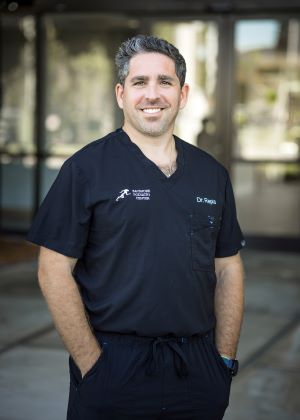
Achilles tendon pain is common in runners, pickleball players, and active professionals—but it rarely improves with “rest” alone. The Achilles has a relatively limited blood supply in a common injury zone a few centimeters above the heel bone, which is one reason chronic cases can linger.
At Bayshore Podiatry Center in South Tampa, we take an investigative approach: we confirm the diagnosis, identify the stage of tendon change, and then match treatment to the mechanics that are keeping the tendon overloaded.
Schedule Your Achilles Tendon Evaluation Today

Achilles “Tendinitis” vs Tendinopathy
A lot of people use the word tendinitis to describe any Achilles pain. Clinically, we see different patterns:
-
Reactive/acute tendon pain: often follows a sudden increase in training volume, speed work, hills, or court sports.
-
Midportion Achilles tendinopathy (chronic): the tendon becomes thickened and disorganized over time—this is a remodeling problem as much as an inflammation problem.
-
Insertional Achilles pain: pain where the tendon attaches to the heel; may be associated with calcification, a bony prominence (Haglund-type irritation), or bursitis.
The reason the distinction matters: the plan changes depending on whether the problem is midportion vs insertional and whether the tendon is reactive vs degenerative.
Why It Happens: The Load Problem
Tendons are load-responsive—they get stronger when they’re loaded correctly and weaker when they’re underloaded or constantly overloaded.
The “Goldilocks loading” goal
We aim for loading that is:
-
Enough to stimulate remodeling
-
Not so much that you flare for 48–72 hours or limp for days
![Athlete with achilles tendon pain and achilles tendinitis]()

Common drivers we see in Tampa
-
Sudden training changes (Gasparilla training cycles, mileage spikes, new pickleball league)
-
Restricted ankle motion and calf tightness (common contributor, not the only one)
-
Foot mechanics and footwear choices (too flat, too flexible, or a big shoe change)
-
Work demands (12-hour hospital shifts, MacDill boot wear, lots of hard surfaces)
The Investigative Diagnostic Process
We don’t guess. We confirm what structure is actually generating pain and what stage of tendon change you’re dealing with.
Diagnostic ultrasound (often our first-line imaging tool)
Ultrasound lets us assess:
-
tendon thickness and fiber pattern
-
partial tearing patterns
-
insertional changes and bursitis
-
Doppler signal (one data point that can be seen in chronic tendinopathy)
Ultrasound is fast, cost-effective, and dynamic—but imaging findings don’t always match pain intensity, which is why we interpret it in the context of your exam and function.
Weightbearing X-rays (when indicated)
Most useful for:
-
insertional calcification
-
Haglund-type bony prominence/impingement patterns
-
ruling out other bony contributors in the right clinical scenario
Functional testing
We evaluate calf strength/endurance and single-leg capacity to match your rehab to what the tendon can currently tolerate.
Schedule Your Achilles Tendon Evaluation Today
The Staged Treatment Pathway
Tendon loading exercise is a first-line treatment in current clinical practice guidelines for midportion Achilles tendinopathy.
Tier 1: Calm the flare and restore walking mechanics
-
Activity rules to stop “re-tearing” the tendon every day
-
Heel lift / supportive shoe in the right phase to reduce strain
-
Short-term offloading when you’re limping (we avoid complete shutdown when possible)
Tier 2: Progressive tendon loading (the real foundation)
We’ll typically use a structured progression that may include:
-
Isometrics early for pain modulation
-
Eccentrics (Alfredson-style heel drops) or heavy-slow resistance depending on the pattern and tolerance
-
A graded plan that builds strength without repeated flare cycles
![performing rehabilitation exercise single leg calf raise for achilles tendon pain]()

Long-term outcomes after eccentric heel-drop programs have been studied, and many patients improve—especially when the plan is executed consistently and paired with the right load management.
Important nuance: insertional Achilles pain often requires modifying range (avoiding aggressive dorsiflexion into deep stretch early), which is different than midportion rehab.
Tier 3: Address the driver so it stops coming back
Depending on your exam, this may include:
-
mobility work and calf/soleus capacity building
-
footwear modifications
-
custom orthotics in select cases (not for everyone—used when mechanics warrant it)
-
return-to-run/return-to-sport progression with clear rules
Advanced Remodeling Options
If you’ve done the basics correctly and you’ve plateaued, we talk about adding a stronger stimulus.
Shockwave therapy (ESWT)
ESWT has evidence supporting its use for Achilles tendinopathy (both insertional and non-insertional in select cases), particularly when combined with a well-designed loading plan.
In our clinic, shockwave is not a standalone fix—it’s an accelerator when the diagnosis is correct and the tendon is ready for the right kind of stimulus.
MLS laser therapy
Laser can be used as a non-invasive adjunct for pain modulation and tissue recovery support as part of an integrated plan (not as a replacement for progressive loading)
Regenerative Medicine: PRP
For select chronic cases—especially degenerative patterns or partial tearing—Platelet-Rich Plasma (PRP) may be appropriate. PRP uses your own blood concentrate to deliver growth factors, typically placed under ultrasound guidance for accuracy.
The key is candidacy: PRP is a tool, not a guarantee, and it works best when paired with mechanics + load correction.
When Urgent Evaluation or Surgery Makes Sense
Red flags that need prompt evaluation
If you felt a sudden pop, have significant bruising/swelling, or can’t push off or perform a single-leg heel raise, you need an evaluation to rule out a rupture.
Acute Achilles rupture
A rupture is time-sensitive in the sense that you should be evaluated promptly, but treatment is not automatically “surgery for everyone.” Both operative and nonoperative pathways can be appropriate depending on your goals, risk factors, and the specifics of the tear.
Chronic insertional impingement / bony conflict
If a bony prominence or insertional calcification is mechanically tearing or compressing the tendon, surgery may be part of the solution (after appropriate conservative care).
Schedule an Achilles Evaluation in South Tampa
If your Achilles pain keeps recurring—or you’re stuck in a plateau—let’s get a clear diagnosis and a staged return-to-activity plan.
Call 813-877-6636 or schedule online.
Serving South Tampa including Hyde Park, Davis Islands, and MacDill Air Force Base.
References
-
JOSPT Clinical Practice Guideline (2024): Achilles Pain, Stiffness, and Muscle Power Deficits—Midportion Achilles Tendinopathy Revision – 2024.
-
Alfredson heel-drop long-term outcomes: van der Plas et al., 5-year follow-up, 2011/2012.
-
ESWT for Achilles tendinopathy: Systematic reviews/meta-analyses (2022–2024).
-
Ultrasound assessment of Achilles tendon: diagnostic MSK ultrasound overview (2025) + imaging description (AJR 2022).